Showing posts with label Dyfed. Show all posts

Saturday, 15 November 2014

Ednyfed, King of Dyfed (fl. 400)

If the tangled royal dynasties of sub-Roman Wales can be trusted, Ednyfed was a member of a powerful and influential Welsh dynasty founded in the fourth century. He was the son of Anwn Dynod and a grandson of Magnus Maximus. His cousin, Mor ap Owain, was the king of Cernyw, and he was linked by marriage to the royal dynasties of Dumnonia, Gwent and Powys.

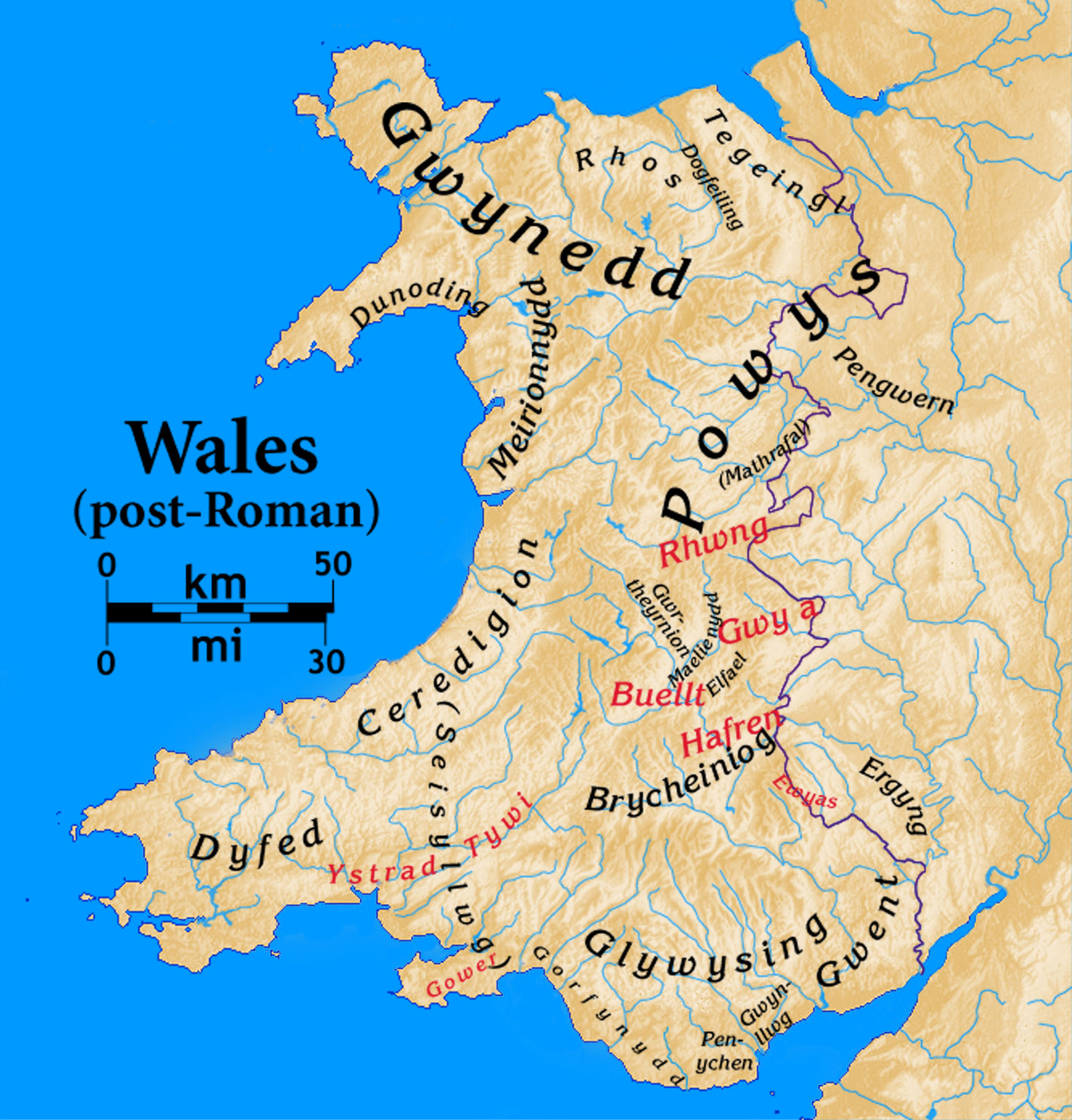
Ednyfed inherited his father's powerbase in southwest Wales in the early fifth century. The area was then still known as Demetia after the local Celtic tribe, the Dematae, but would become corrupted to Dyfed within the next couple of generations.

Very little is known as Ednyfed's reign. Like his father, he may still have considered himself more Roman than Welsh and ruled as a Roman-style protector rather than a true king. Roman troops had withdrawn from Britain in 410 AD and the kingdom of Demetia appears to have weathered this turbulent time fairly well. Desai mercenaries, led by Aed Brosc and the later by his son, Urb, helped defend the Dyfed coast against Irish raiders just as they had done under Anwn Dynod.

Ednyfed married a woman whose name has been lost to history and had at least two sons, Clotri and Dyfanwal. He died around 410 AD and was succeeded by Clotri. His second son, Dyfanwal, may have become a sub-king; if this is true then it suggests a slow return to Celtic-style leadership in which kingdoms are split between heirs. 

Tuesday, 11 November 2014

Aed Brosc (fl. 382 - 405?)

There was a lot of Irish migration to Wales in
the fourth century. The Desai fled Ireland after
a failed bid for independence and eventually
settled in Dyfed as mercenaries.
Aed Brosc was a warrior and key figure from the Desai tribe who had settled along the Dyfed coast in southwestern Wales in the late fourth century. Several years before, his grandfather, Eochaid Allmuir, had led a failed bid for independence which had been severely crushed by the Irish High King. Fearing retribution, the Desai fled Ireland, sailing across the Irish Sea to Britain.

The Roman Commander of Britain at the time was Magnus Maximus, who would later go on to become Western Roman Emperor. At a time when Roman military strength was stretched, he made very effective use of mercenaries to protect the remoter parts of Britain. The Desai, led by Aed Brosc, were allowed to settle in Dementia (modern-day Dyfed) in 382 AD and in return became mercenaries, protecting the Dyfed coast against Irish raiders. This arrangement continued after Magnus Maximus's death in 388 AD. One of Magnus Maximus's sons, Anwn Dynod, had been given authority over Demetia sometime in the 380s and it appears that Aed Brosc fought alongside him to drive off the Irish warbands that continued to plague the Welsh coast.

Not much is known about Aed Brosc personally. He must have been a strong character to lead a dispossessed tribe across the Irish Sea, and also a loyal man who helped protect his new homeland even as Roman authority crumbled. He had at least two sons and indirectly founded two royal dynasties. The descendants of his eldest son, Urb, would found the kingdom of Brycheiniog in the mid-fifth century and his younger son, Triffyn, would go on to marry Gweldyr, the sole surviving heiress of the Demetian kings in 421 AD. Aed Brosc's death is not recorded but he probably died before the Roman withdrawal in 410 AD.

Monday, 10 November 2014

Anwn Dynod / Antonius Donatus Gregorius (c.382 - c.400?)

When Magnus Maximus left Britain to pursue his imperial ambitions on the continent, he left behind his British wife, Elen Lwyddog, and their children. Having become Western Roman Emperor in 383 AD, and perhaps foreseeing the fading of Roman administration in the provinces, Magnus Maximus returned to Britain and began transferring local authority to local leaders. This extended to his sons - Owain Finddu, Anwn Dynod and Custennin - who were given control of territories in Wales. 

Anwn Dynod's protectorate was based in southwestern
Wales, centred on the territories of the Demetae tribe.
Over time, the territory became the kingdom of Dyfed.
Like his brothers, Anwn Dynod - otherwise known as Antonius Donatus Gregorius -  appears to have been accepted by the Britons as a leader. His protectorate of Southwest Wales was centred on the territories of the Celtic Demetae tribe and his capital was most likely at Moridunum (modern-day Caermarthen). Anwn Dynod would have ruled more as a Roman governor rather than a Celtic king and, although he and his brothers have been given Welsh names by later chroniclers, it's much more likely they would have considered themselves Roman.

As Roman control over the remote areas of Britain crumbled in the late fourth century, Irish warbands started to raid along the Welsh coast, seizing booty in the form of cattle, corn and captives to sell into slavery. Much of Anwn's reign was spent fighting off these raiders with the help of Aed Brosc and his Desai warriors who had been settled in southwestern Wales several years earlier by Magnus Maximus. 


Anwn Dynod's death is not recorded but he probably didn't live to see the Roman withdrawal in 410 AD. It is entirely possible that, like his brother, Owain, he was killed in battle with the Irish. He was succeeded by his son, Ednyfed - or Demetius to give him his Roman name - who later founded the kingdom of Dyfed.