Showing posts with label Wales. Show all posts

Saturday, 15 November 2014

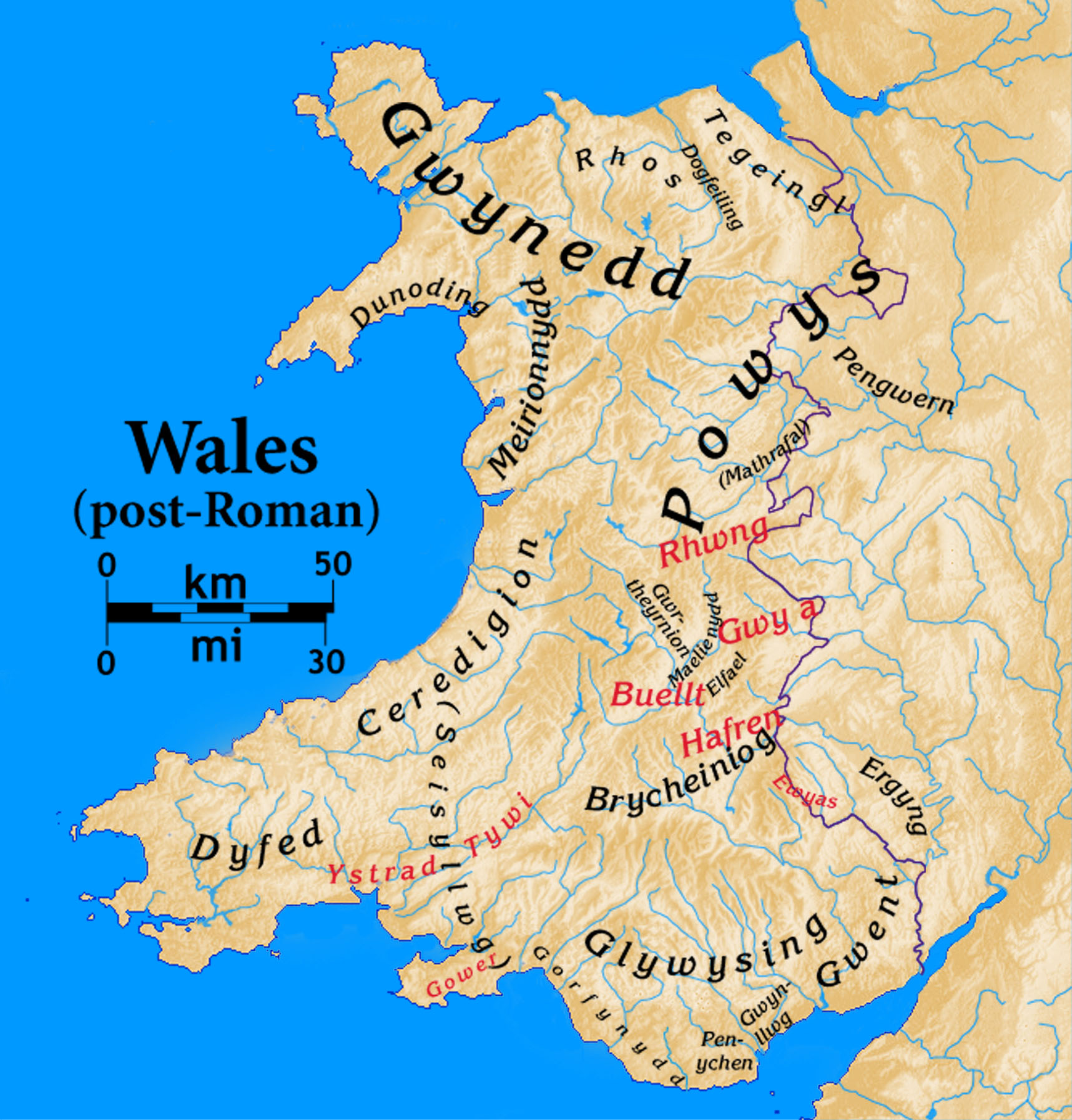
Ednyfed, King of Dyfed (fl. 400)

If the tangled royal dynasties of sub-Roman Wales can be trusted, Ednyfed was a member of a powerful and influential Welsh dynasty founded in the fourth century. He was the son of Anwn Dynod and a grandson of Magnus Maximus. His cousin, Mor ap Owain, was the king of Cernyw, and he was linked by marriage to the royal dynasties of Dumnonia, Gwent and Powys.

Ednyfed inherited his father's powerbase in southwest Wales in the early fifth century. The area was then still known as Demetia after the local Celtic tribe, the Dematae, but would become corrupted to Dyfed within the next couple of generations.

Very little is known as Ednyfed's reign. Like his father, he may still have considered himself more Roman than Welsh and ruled as a Roman-style protector rather than a true king. Roman troops had withdrawn from Britain in 410 AD and the kingdom of Demetia appears to have weathered this turbulent time fairly well. Desai mercenaries, led by Aed Brosc and the later by his son, Urb, helped defend the Dyfed coast against Irish raiders just as they had done under Anwn Dynod.

Ednyfed married a woman whose name has been lost to history and had at least two sons, Clotri and Dyfanwal. He died around 410 AD and was succeeded by Clotri. His second son, Dyfanwal, may have become a sub-king; if this is true then it suggests a slow return to Celtic-style leadership in which kingdoms are split between heirs. 

Friday, 14 November 2014

Urb mac Aed (fl. 391 AD)

Urb mac Aed, along with the rest of the Deisi, settled along the
Dyfed coast and protected Demetia from Irish raiders in the
fourth and fifth centuries.

Urb was the son of Aed Brosc and, like his father, was a Deisi chieftain and warrior in the late fourth century. The Deisi had fled Ireland two generations earlier after a failed bid for independence had infuriated the Irish High King. The homeless Deisi were employed as mercenaries in 382 AD by Magnus Maximus, the Commander of Britain and later Western Roman Emperor. In return for protecting the kingdom of Demetia (later to become Dyfed), the Deisi were given land along the coast. Aed Brosc is thought to have died sometime around 405 AD and it's presumed that Urb, as his eldest son, inherited his leadership. 

Very little is known of Urb. Presumably he and the rest of the Deisi continued to defend the Dyfed coast against Irish raiders. Urb had at least one son, Cormac, and a younger brother, Triffyn, who would go on to marry Gweldyr, the sole heiress of Demetia and become King of Dyfed. At some point in the 390s, Urb moved his family east to the Brecon Beacons where, two generations later, his grandson, Brychen, would found the kingdom of Brycheiniog in the mid-fifth century. His death is not recorded and it's probable that his son, Cormac, became the chieftain of the Deisi. 

Wednesday, 12 November 2014

Cunedda Wledig (fl. 430 AD)

Cunedda and his band of Romanised Picts travelled south to 
Wales and drove out the Irish who had settled there several
generations earlier. He may have been employed as a 
mercenary by the Romano-British authorities or simply seized 
an opportunity to carve out a kingdom.

Cunedda Wledig was a powerful warrior prince from Manau-Gododdin who migrated to Wales in the early fifth century and founded a dynasty from which Welsh nobility would claim ancestry for centuries afterward.

According to tradition, Cunedda was descended from a line of Votadini chieftains whose Latinised names suggest they ruled in some sort of official Roman capacity north of Hadrian’s Wall. By Cunedda’s time, the Manau-Gododdin was a sub-kingdom of Goutodin and it is likely that Cunedda was some sort of leader or sub-king. Not much is known of his life in the north. Cunedda must have been a charismatic warrior as he was able to rally the beleaguered Romano-British to fight off constant Irish and Pictish raids. Perhaps because of his actions, Cunedda managed to secure a politically advantageous marriage to Gwawl, a daughter of Coel Hen, and is claimed to have had nine sons and at least two daughters.

At some point in the early fifth century, maybe around 430, Cunedda and his warband migrated southwest to Wales. His wife, Gwawl, appears to have gone with him, as did his younger sons. His eldest son, Typaun, remained behind in Manau-Gododdin and presumably inherited whatever role it was that Cunedda relinquished when he left. According to legend, Cunedda was offered land in return for ousting Irish raiders (named as the Ui Liathain from Munster) who had invaded and settled along the Welsh coastline during the last century. Nennius, writing centuries later, wrote that Cunedda and his warband arrived in Wales “and with great slaughter they drove out from these regions the Scotti who never returned again to inhabit them”.

Alternatively, it has been suggested that Cunedda may have sailed down the Irish Sea of his own volition and invaded North Wales, establishing himself a kingdom during the chaos that resulted from a plague that swept southern Britain in 446 and the subsequent Saxon laeti revolt. Northern Wales had been governed by Custennin, a son of Magnus Maximus, but presumably Custennin had either died by this point or unable to put up much resistance. 

With only the westernmost parts of Wales remaining in Irish hands, Cunedda settled down in Gwynedd and founded both a kingdom and a dynasty. His sons went on to found royal dynasties of their own in kingdoms which would later be named after them; Ceredigion, Meirionnydd, Ysfeilion, Rhufoniog, Dunoding, Afflogion and Edeyrnion.

Tuesday, 11 November 2014

Aed Brosc (fl. 382 - 405?)

There was a lot of Irish migration to Wales in
the fourth century. The Desai fled Ireland after
a failed bid for independence and eventually
settled in Dyfed as mercenaries.
Aed Brosc was a warrior and key figure from the Desai tribe who had settled along the Dyfed coast in southwestern Wales in the late fourth century. Several years before, his grandfather, Eochaid Allmuir, had led a failed bid for independence which had been severely crushed by the Irish High King. Fearing retribution, the Desai fled Ireland, sailing across the Irish Sea to Britain.

The Roman Commander of Britain at the time was Magnus Maximus, who would later go on to become Western Roman Emperor. At a time when Roman military strength was stretched, he made very effective use of mercenaries to protect the remoter parts of Britain. The Desai, led by Aed Brosc, were allowed to settle in Dementia (modern-day Dyfed) in 382 AD and in return became mercenaries, protecting the Dyfed coast against Irish raiders. This arrangement continued after Magnus Maximus's death in 388 AD. One of Magnus Maximus's sons, Anwn Dynod, had been given authority over Demetia sometime in the 380s and it appears that Aed Brosc fought alongside him to drive off the Irish warbands that continued to plague the Welsh coast.

Not much is known about Aed Brosc personally. He must have been a strong character to lead a dispossessed tribe across the Irish Sea, and also a loyal man who helped protect his new homeland even as Roman authority crumbled. He had at least two sons and indirectly founded two royal dynasties. The descendants of his eldest son, Urb, would found the kingdom of Brycheiniog in the mid-fifth century and his younger son, Triffyn, would go on to marry Gweldyr, the sole surviving heiress of the Demetian kings in 421 AD. Aed Brosc's death is not recorded but he probably died before the Roman withdrawal in 410 AD.

Monday, 10 November 2014

Anwn Dynod / Antonius Donatus Gregorius (c.382 - c.400?)

When Magnus Maximus left Britain to pursue his imperial ambitions on the continent, he left behind his British wife, Elen Lwyddog, and their children. Having become Western Roman Emperor in 383 AD, and perhaps foreseeing the fading of Roman administration in the provinces, Magnus Maximus returned to Britain and began transferring local authority to local leaders. This extended to his sons - Owain Finddu, Anwn Dynod and Custennin - who were given control of territories in Wales. 

Anwn Dynod's protectorate was based in southwestern
Wales, centred on the territories of the Demetae tribe.
Over time, the territory became the kingdom of Dyfed.
Like his brothers, Anwn Dynod - otherwise known as Antonius Donatus Gregorius -  appears to have been accepted by the Britons as a leader. His protectorate of Southwest Wales was centred on the territories of the Celtic Demetae tribe and his capital was most likely at Moridunum (modern-day Caermarthen). Anwn Dynod would have ruled more as a Roman governor rather than a Celtic king and, although he and his brothers have been given Welsh names by later chroniclers, it's much more likely they would have considered themselves Roman.

As Roman control over the remote areas of Britain crumbled in the late fourth century, Irish warbands started to raid along the Welsh coast, seizing booty in the form of cattle, corn and captives to sell into slavery. Much of Anwn's reign was spent fighting off these raiders with the help of Aed Brosc and his Desai warriors who had been settled in southwestern Wales several years earlier by Magnus Maximus. 


Anwn Dynod's death is not recorded but he probably didn't live to see the Roman withdrawal in 410 AD. It is entirely possible that, like his brother, Owain, he was killed in battle with the Irish. He was succeeded by his son, Ednyfed - or Demetius to give him his Roman name - who later founded the kingdom of Dyfed.

Sunday, 9 November 2014

Owain Finddu (c.383 - c.440)

An early king of Mid-South Wales, Owain Finddu - or Eugenius to give him his Roman name -  is a shadowy historical figure about whom little is known for sure. Tradition claims him as a son of Magnus Maximus, the Western Roman Emperor, and his British wife, Elen Lwyddog. The royal genealogies for the early Dark Ages in Britain are seriously tangled due to inventive medieval genealogists who, desperate to claim descent from Romano-British power, played havoc with names, dates and lineages. It's probable than a man named Owain Finddu did exist, but it is entirely possible that Magnus Maximus was not his father. 

Post-Roman Wales. Owain would have ruled the area of
Gywysing in southern Wales. Gwent, to the east, was
taken over by Vortigern in c.430 AD.
Tradition states that after the fading of Roman power in Britain, Magnus Maximus made his three sons - Owain Finddu, Anwn Dynod, and Custennin - protectors of areas of Wales. Owain was most likely based at Tamium (modern-day Cardiff) and his protectorate stretched across much of modern-day Glamorganshire in South Wales. This western chunk of what had been Silures territory was the most Romanised part of Wales and Owain would have ruled more as a Roman-style governor rather than a Celtic king. 

Given the chaos of the Roman withdrawal in the early fourth century, Owain's reign seems to have been fairly stable. By around 430 AD, however, he appears to lose control of Ewyas, an area to the west, to his brother-in-law, Vortigern. Vortigern granted his new territory to his son, Vortimer, and a new Welsh kingdom emerged by the name of Gwent. Perhaps in recognition of this loss, Owain's territory of Mid-South Wales was renamed Cernyw around 437 AD. 


Like his father, mother and siblings, Owain makes an appearance in medieval Welsh folktales, especially the Mabinogion which records his death in around 440 AD. According to the legend, Owain and his younger brother, Custennin, were escorting their mother through the dangerous mountains of Snowdonia when they were attacked near by Cidwn, an evil giant. In the fierce battle that followed, Owain managed to kill the giant but was mortally wounded. On his deathbed, he shot an arrow into the sky and asked to be buried where it fell.

It is not known for sure how Owain died. As Roman control of Britain crumbled, Irish warbands started to raid along the Welsh coast and even up the Severn, seizing booty in the form of cattle, corn and even children, including the young St. Patrick. Given his geographical location, it's likely that Owain died at the hands of Irish raiders - a humdrum death spiced up by later medieval chroniclers. After his death, he was succeeded by his son, Mor. 

Saturday, 8 November 2014

Custennin Fawr (c.380s - ? AD)

Custennin Fawr was an early king of North Wales who may or may not have existed. The only mentions of him are in unreliable royal genealogies and medieval Welsh legend, especially the cycle of folktales contained within the Mabinogion.  According to the myths of the Mabinogion, Custennin was the youngest son of Magnus Maximus, the Roman Emperor, and his British wife, Elen Lwyddog, otherwise known as St. Elen of the Hosts. The royal genealogies show that after the collapse of Roman power in Britain, Custennin and his brothers, Anwn Dynod and Owain Finddu, were granted kingships in Wales by their powerful father. At least two of his sisters married powerful kings in other parts of Britain; Gratiana married Tudwal ap Gwrfawr of Dumnonia and Severa married Vortigen, King of Powys and later High King of Britain.

The royal genealogies for the early Dark Ages in Britain are seriously tangled due to inventive medieval genealogists who, desperate to claim descent from Romano-British power, played havoc with names, dates and lineages. It is entirely possible that neither Elen Lwyddog nor her children existed at all. The existence of Custennin is particularly doubtful. Custennin Fawr is Welsh for Constantine the Great and there appears to be almost willful confusion between him and the Roman Emperor Constantine I whose mother was St. Helen. 

If Custennin did exist. then he may have been a dux, a provincial Roman governor, who took on a role of kingship as Roman administration faded in the early fifth century. Alternatively he may have been an opportunistic Romano-British aristocrat who seized power in the wake of the Roman withdrawal. Whatever the case, his deeds as King of North Wales and how he earned the epitaph "the Great" have been completely forgotten by history. By the 430s, Cunedda Wledig and his warband of Romanised Picts had carved out a kingdom in North Wales so it is presumed that Custennin was either dead by this point or gave up his kingdom with little resistance. 

Thursday, 6 November 2014

Pascent, King of Builth (c.406 - 440)

Britain in 400 AD. Vortigern's powerbase of Powys was divided
into three portions, one for each of his sons. Pascent ruled the
kingdom of Builth in central Wales.

Pascent was the third and youngest son of Vortigern and Sevira, a daughter of Magnus Maximus. His father was probably from a powerful family in Powys and through his mother, he was related to the royal dynasties of Dumnonia, Demetia and Cernyw. 

Sometime in the early fifth century, Vortigern came to power as High-King of Britain and divided the nascent kingdom of Powys into three portions, one for each of his sons. Vortimer, his eldest son, took control of Gwent, his second son, Catigern, was given the Pagenses, and Pascent received the smaller territories of Builth and Gwerthrynion.

Pascent was the only one of Vortigern's sons to outlive his father. His father was overthrown by a Saxon revolt led by Hengist and Horsa in Kent and both of his elder brothers died in battle soon after. Not much is known of his life. Like his father, he has his own set of legends and the Historia Brittonum, written in the twelfth century, records an entirely mythological account of his reign and lifelong enmity with Ambrosius Aurelianus. 


Even though his brothers predeceased him, Pascent seems to have respected their heirs and there is no record of any attempts to overthrow his young nephews or expand his own kingdom. He married a woman whose name has been lost to history and had at least two sons, Braciat and Morgan. He died around 440 AD and was succeeded by Braciat. His younger son, Morgan, may have ruled as a sub-king, as was usual in the Celtic tradition.

Saturday, 1 November 2014

Magnus Maximus (? - 388 AD)

Magnus Maximus was born in Gallaecia (northwestern Spain) on the estates of Count Theodosius, a senior military officer. He may have been a relative of Count Theodosius, or his family may have simply been workers on the estate.

Maximus distinguished himself as a military leader from a young age. He may have been stationed in Britain in 368 AD as a junior officer where he helped to repel Pictish and Scottish invaders who were attempting to capitalise on the depleted military garrison in Britain after Magnentius' unsuccessful bid to become emperor twenty years earlier. In 372 AD, Maximus served under Count Theodosius in Africa and then in 376 AD he campaigned along the Danube. His efforts were rewarded in 380 AD when he was made Commander of Britain.

The Roman Empire at that time was ruled by Gratian in the west and Theodosius I, the son of Count Theodosius, in the east. Gratian was an unpopular emperor, especially with the legions, and in 383 AD, Maximus was proclaimed emperor by his troops in Britain. Maximus immediately left the province, taking most of the army with him, and defeated Gratian in battle near Paris. Buoyed by his success, and with his army swelled by those who had deserted Gratian, Maximus marched on Italy to overthrow Gratian's son, the twelve year emperor Valentinian II. He was only prevented from doing so by the military intervention of Theodosius I. Theodosius I, wanting to protect Valentinian II and concerned with his own troubles in the east, reluctantly made Maximus emperor of Gaul, Britain, Hispania and the African Provinces while Valentinian II kept Italy. 

Magnus Maximus was a popular emporer. Although he established his capital at Augusta Trevorum (Trier, France), Maximus returned regularly to Britain to campaign against the Picts and Scots in support of Rome's long-standing Celtic allies in southern Scotland. He used foederati (mercenary forces) to great effect and while in Britain, it is likely he started to transfer local powers to local rulers, such as Coel Hen in the north. Like Theodosius I, Maximus was a Christian emperor who persecuted pagans and heretical Christians, although he appears to have been tolerant of other faiths, even reprimanding Christians in Rome for burning down a synagogue in 387 AD.

In 387 AD, Maximus elevated his infant son, Flavius Victor, to co-emperor. Later the same year, Maximus once again invaded Italy, forcing Valentinian II to flee from Milan to the court of Theodosius I. With his troubles in the east solved, Theodosius marched west and defeated Maximus at the Battle of the Save (modern-day Croatia) in 388 AD. With his top general and brother dead, Maximus retreated to Aquileia in northern Italy where he quickly surrendered.  

Despite his pleas for mercy, Magnus Maximus was executed as a traitor in 388 AD. His young son, Flavius Victor, was also killed although what became of the rest of his family is unclear. Magnus Maximus - or Macsen Wledig, to give him his Welsh name - is a prominent figure in Welsh legend and is listed as a founding ancestor in the genealogies of several Welsh royal dynasties. Tradition has it that he married Elen Lwyddog, a Welsh princess, and his sons and daughters, presumably safe in Britain after his death, went on to found royal dynasties of their own.