Showing posts with label Roman Emperors. Show all posts

Tuesday, 4 November 2014

Constans (c.323 - 350 AD)

Constans was born in 323 AD, the third and youngest son of Constantine I and his second wife, Fausta. He was educated at his father's court in Constantinople and in 333 AD, at ten years old, was elevated to Caesar. 

Constantine I died in 337 AD, leaving Constans and his two elder brothers, Constantine II and Constantius II, as co-emperors and their cousins, Dalmatius and Hannibalius, as Caesars. This arrangement, made two years earlier, barely lasted a month as the three brothers swiftly arranged the murders of Dalmatius and Hannibalius as well as virtually all other relatives who could have had a claim to the throne. 
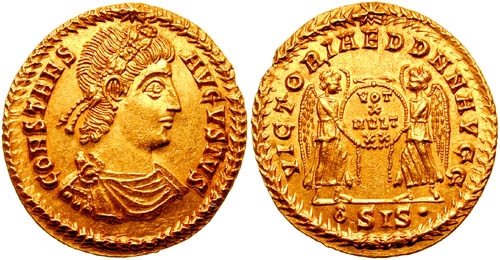
Roman coins engraved with Constans' name and image

Constans' share of the Roman world was Italia and the African provinces, a small portion when compared to the territories of his two elder brothers. A meeting of the three brothers in Viminacium (modern-day Serbia) in 338 AD granted Constans the additional territories of Illyricum and Thrace. This increase of Constans' power hugely annoyed his eldest brother, Constantine II, who ruled the western provinces. 

In an attempt to maintain the fragile peace, Constans handed the African provinces to Constantine II but he became ever more reluctant to accept his eldest brother's seniority. Tensions between the brothers heightened when Constantine II refused to hand over the guardianship of his younger brother's territories when Constans came of age. Things came to a head when, in 340 AD, Constantine II invaded Italy. Constans, busy suppressing a rebellion in Dacia, desperately dispatched a small unit of Illyrian troops who, against all odds, managed to ambush and kill Constantine II near the town of Aquileia in northern Italy. Constans seized control over his brother's former provinces of Gaul, Britain and Hispania and became joint-emperor with Constantius II.

Constans had an energetic start to his reign. In 341 AD he lead a successful campaign against the Franks and in 343 AD made a short and unusual visit to Britain. The reason for Constans' trip to one of his remotest provinces is unrecorded but it was followed by widespread re-fortification of towns and the appearance of Germanic mercenaries in East Anglia and along the southeastern coast. His relationship with Constantius was strained at best. Like their father, both brothers became entangled in the squabbles of the various sects of the early Christian Church and their religious differences almost led to open warfare. However, in 346 AD, the co-emperors simply agreed to disagree.

In the final years of his reign, Constans gained an unsavory reputation for cruelty, misrule and 'scandalous behaviour with handsome barbarian hostages'. Crucially, he became unpopular with the army and in 350 AD a Roman general by the name of Magnentius declared himself emperor at Augustodunum (modern-day Autun, France) with the support of the Roman troops in the western provinces. With no support beyond his immediate household, Constans was forced to flee for his life. However, he was swiftly cornered by Magnentius's men in the Pyrenees and killed while seeking sanctuary in a temple in Vicus Helena (modern-day Elne, France).

Magnentius' rebellion lasted less than a year. Constantius II defeated the usurper twice in battle and reclaimed his brother's territories, ruling as sole emperor until elevating his cousin, Constantius Gallus, to Caesar in 351 AD.

Monday, 3 November 2014

Constantine II (317 - 340 AD)

Constantine II was born at Arelate (modern-day Arles, France), the eldest son of Constantine I and his second wife, Fausta. His date of birth is recorded as February 317 AD but this is doubtful as his younger brother, Constantius, was born in August the same year. It's possible that he was actually born a year earlier in 316 AD or, and this is entirely possible, Constantine II was illegitimate and not Fausta's son at all.

Constantine I was relentless when it came to securing power and status for both Constantine and his elder half-brother, Crispus. Less than a year after his birth, Constantine II had been elevated to the rank of Caesar and by 320 AD was a counsel, the highest political office in the Roman Empire. This shameless promotion of infants too young to sign their own names was a huge source of friction between Constantine I and his co-emperor, Licinius who was eventually deposed by Constantine I in 324 AD. 

A statue of Constantine II in Rome
Constantine I also made sure his sons held respected, but naturally ceremonial, military positions. At the tender age of seven, Constantine accompanied his father on campaigns against the Sarmatians in 323 AD and, three years later, was made Commander of Gaul after the death of Crispus. How Crispus died is unclear; he may have been executed for treason or adultery or even assassinated on the orders of Constantine I in order to clear the way for the succession of his three other sons. 

Constantine I died in 337 AD, leaving his three sons, Constantine II, Constantius and the teenage Constans, as co-emperors with their cousins, Dalmatius and Hannibalius, as Caesars. This arrangement, made two years earlier, collapsed as the three brothers swiftly arranged the slaughter of the rest of the family. The Roman Empire was split three ways with Constantine II taking control over Gaul, Britain and Hispania and acting as guardian for Constans who, at only fourteen years old, was too young to rule on his own.

Almost immediately, and perhaps inevitably, the brothers began to argue among themselves. Both Constantine II and Constantius got involved in the squabbling between the different sects of the early Christian church. Constantine started demanding a larger portion of the empire as the eldest son and was given the African provinces by Constans, who sought to maintain the fragile peace.

More squabbles followed when Constantine II, having got used to controlling large swathes of the empire, refused to relinquish control when Constans came of age. Understandably, Constans became increasingly unwilling to accept his elder brother as the senior emperor. Things came to a head when Constantine II declared war on his brother and marched his troops into Italy in 340 AD. Constans, who was in Dacia at the time, immediately dispatched a small unit of his Illyrian troops who managed to ambush and kill Constantine II near Aquileia, Italy. Constantine II left no legitimate heirs and his share of the empire was seized and ruled by Constans.


Sunday, 2 November 2014

Constantine the Great (c.272 - 337)

Constantine the Great, also known as Constantine I or Saint Constantine, was Roman Emperor from 306 until his death in 337 AD. He is famous for being the first Roman Emperor to convert to Christianity.

Born in Serbia in about 272 AD, Constantine was the son of Constantius, a Roman military officer, and Helena, a concubine. The Roman Empire at that time was ruled by two senior co-emperors, or Augusti, one in the east and one in the west, and at least two junior emperors, known as Caesars. Constantine's father rose swiftly through the military ranks and eventually became Caesar of Britain, Gaul and Spain in 293 AD. Constantine was sent to the court of Diocletian, the Eastern Augustus, probably as a high-status hostage to ensure his father's cooperation. 

Constantine was educated at Diocletian's court, became a tribune, a sort of aristocratic military officer, and campaigned in Syria, Mesopotamia and along the Danube. While in the east, he also witnessed Diocletian's savage persecution of Christians. In 305 AD, Diocletian abdicated, as did his co-emperor in the west, Maximian. Constantine's father, Constantius, was elevated to western Augustus and, to great surprise, a man named Galarius was chosen to succeed Diocletian. Constantine was ignored completely, as was Maxentius, the son of Maximian. 

Perhaps fearing for his son's life at Galarius's court, Constantius immediately recalled Constantine to Britain to campaign with him against the Picts. Less than a year later, Constantius died at Eboracum (modern-day York). Roman troops in Britain and Gaul quickly proclaimed Constantine as the new western Augustus. Furious, but unwilling to risk a military revolt, Galarius had no choice but to accept Constantine as emperor of Britain, Gaul and Spain. 

A statue of Constantine the Great in York, where he was first proclaimed emperor in 306 AD
Galarius' death in 311 AD triggered a series of dynastic wars as various successors, including Constantine, Maximian and Maxentius, struggled for power. It was on the eve of one of these battles that Constantine is said to have converted to Christianity. The story goes that Christ appeared to Constantine in a dream and showed him a flaming cross in the sky with the words In hoc signo vinces - in this sign you shall conquer. Constantine did win the battle and ultimately the war, emerging victorious in 313 AD as the western Augustus. Nine years later, Constantine deposed his co-emperor to become sole ruler of both east and west. 

Constantine the Great is revered as a
saint in the Eastern Orthodox Church. His
feast day is the 21 May.
As emperor, Constantine earned his epitaph by campaigning successfully against the tribes on the Empire's frontiers and even managing to resettle territories lost during the last century. He restructured the government, separated military and civil authority and reorganised the army.

One of his biggest legacies, however, was rejecting Rome as the most important city in the empire and building himself a new capital in the east, modestly naming it Constantinople (modern-day Istanbul). By building his capital at Constantinople, Constantine effectively founded what would later become the Byzantine Empire.

Constantine is most famous as the first Roman Emperor to convert to Christianity. When he converted is a matter for debate. Tradition has him converting on the eve of battle in 312 AD, but, as his mother was Christian, he may have converted as a young boy or he may have adopted the faith gradually over his life.

Even during his early reign in Britain and Gaul, Constantine was tolerant of Christianity and discouraged persecution. In 313 AD, he and his co-emperor signed the Edict of Milan, allowing Christians to practice their faith openly and freely. Constantine also encouraged church leaders to come together to solve contentious issues at meetings such as the Council of Nicaea in 325 AD. Constantine's tolerance of Christianity meant that the Christian faith flourished and smoothed the way for it becoming the dominant religion in Europe.

After a short illness, Constantine died in 337 in Nicomedia (modern-day Iznit, Turkey), a day after being baptized in the River Jordan, and was succeeded by his three sons, Constantine II, Constantius II and Constans.

Saturday, 1 November 2014

Magnus Maximus (? - 388 AD)

Magnus Maximus was born in Gallaecia (northwestern Spain) on the estates of Count Theodosius, a senior military officer. He may have been a relative of Count Theodosius, or his family may have simply been workers on the estate.

Maximus distinguished himself as a military leader from a young age. He may have been stationed in Britain in 368 AD as a junior officer where he helped to repel Pictish and Scottish invaders who were attempting to capitalise on the depleted military garrison in Britain after Magnentius' unsuccessful bid to become emperor twenty years earlier. In 372 AD, Maximus served under Count Theodosius in Africa and then in 376 AD he campaigned along the Danube. His efforts were rewarded in 380 AD when he was made Commander of Britain.

The Roman Empire at that time was ruled by Gratian in the west and Theodosius I, the son of Count Theodosius, in the east. Gratian was an unpopular emperor, especially with the legions, and in 383 AD, Maximus was proclaimed emperor by his troops in Britain. Maximus immediately left the province, taking most of the army with him, and defeated Gratian in battle near Paris. Buoyed by his success, and with his army swelled by those who had deserted Gratian, Maximus marched on Italy to overthrow Gratian's son, the twelve year emperor Valentinian II. He was only prevented from doing so by the military intervention of Theodosius I. Theodosius I, wanting to protect Valentinian II and concerned with his own troubles in the east, reluctantly made Maximus emperor of Gaul, Britain, Hispania and the African Provinces while Valentinian II kept Italy. 

Magnus Maximus was a popular emporer. Although he established his capital at Augusta Trevorum (Trier, France), Maximus returned regularly to Britain to campaign against the Picts and Scots in support of Rome's long-standing Celtic allies in southern Scotland. He used foederati (mercenary forces) to great effect and while in Britain, it is likely he started to transfer local powers to local rulers, such as Coel Hen in the north. Like Theodosius I, Maximus was a Christian emperor who persecuted pagans and heretical Christians, although he appears to have been tolerant of other faiths, even reprimanding Christians in Rome for burning down a synagogue in 387 AD.

In 387 AD, Maximus elevated his infant son, Flavius Victor, to co-emperor. Later the same year, Maximus once again invaded Italy, forcing Valentinian II to flee from Milan to the court of Theodosius I. With his troubles in the east solved, Theodosius marched west and defeated Maximus at the Battle of the Save (modern-day Croatia) in 388 AD. With his top general and brother dead, Maximus retreated to Aquileia in northern Italy where he quickly surrendered.  

Despite his pleas for mercy, Magnus Maximus was executed as a traitor in 388 AD. His young son, Flavius Victor, was also killed although what became of the rest of his family is unclear. Magnus Maximus - or Macsen Wledig, to give him his Welsh name - is a prominent figure in Welsh legend and is listed as a founding ancestor in the genealogies of several Welsh royal dynasties. Tradition has it that he married Elen Lwyddog, a Welsh princess, and his sons and daughters, presumably safe in Britain after his death, went on to found royal dynasties of their own.